
My AI Native UX Workflow Approach
I’ve evolved my traditional design approach into an AI-enhanced process. The fundamentals that have served me throughout my career remain, but I now use AI to accelerate ideation, synthesis, exploration, and iteration. Tools such as Notion, Zoom, Claude, GPT, Perplexity, and Gemini help me work more efficiently, explore more possibilities earlier, and reduce the time from idea to validated product direction.
SENSE MAKING - Research and signal detection
| AI Speeds Up My Task | What I Lead |
|---|---|
| Interview transcript synthesis | Choosing what questions matter |
| Pattern clustering across sessions | Reading emotional subtext |
| Sentiment trend analysis | Deciding what’s signal vs. noise |
| Desk research at scale | Defining the research frame |
FRAME THE PROBLEM - Strategy and problem definition
| AI Speeds Up My Task | What I Lead |
|---|---|
| Generating opportunity hypotheses | Selecting the right problem |
| Drafting HMW statements | Setting success criteria |
| Mapping competitive patterns | Navigating org politics |
| Synthesizing stakeholder inputs | Aligning product and business |
GENERATE IDEAS- Design and Exploration
| AI Speeds Up My Task | What I Lead |
|---|---|
| Rapid concept variations | Selecting the right problem |
| Copy and microcopy drafts | Setting success criteria |
| Component scaffolding | Navigating org politics |
| Accessibility checks | Aligning product and business |
VALIDATION - Testing and evidence
| AI Speeds Up My Task | What I Lead |
|---|---|
| Rapid concept variations | Taste and curation |
| Copy and microcopy drafts | System coherence decisions |
| Component scaffolding | Emotional resonance judgment |
| Accessibility checks | Which variant is actually right |
MONITOR - Post-launch intelligence
| AI Speeds Up My Task | What I Lead |
|---|---|
| Anomaly detection in funnels | Deciding what metrics matter |
| NPS and CSAT theme extraction | Explaining the why behind data |
| Session replay summarisation | Advocating for the user in reviews |
| Automated metric reporting | Closing the loop to research |
My Design Experience Operating (DXO) Model
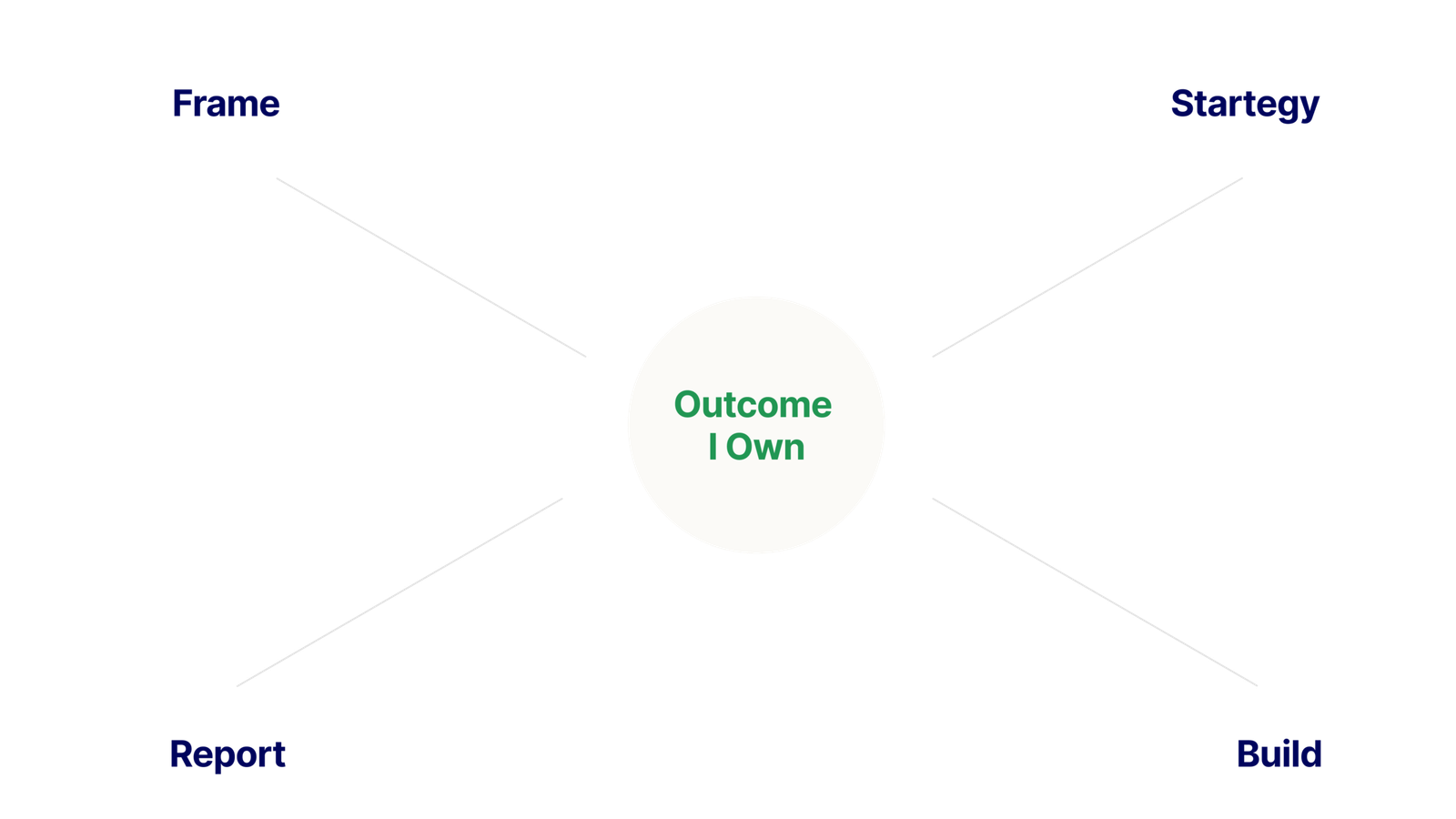
Throughout my career, I’ve brought cross-functional teams together around a shared North Star, creating the structure, clarity, and decision-making needed to move work forward. This isn’t a design process—it’s an operating model. Design craft is an essential part of the engine, but it’s only one part of how teams align, make decisions, and deliver outcomes.
1
JTBD I establish why the work matters before we start designing—what business outcome we’re trying to change, why it matters now, and what’s at risk if we get it wrong or deliver too late. If we can’t answer those questions clearly, we’re not ready to design the solution.
2
I define how the work gets done before the team starts building—who owns which decisions, what capabilities we need, what we build versus buy, and how design, product, and engineering work together around the problem.
3
Research > Concepts > Build > Deploy > Feedback > Iterate > Build: This is where the craft happens—understanding the problem, exploring possibilities, building solutions, and learning from what happens in the real world. It’s essential work, but it’s the engine inside the larger model, not the model itself.
4
I translate the work into what leaders need to know: where we’re making progress, where risk is emerging, and where a decision, alignment, or support is needed to keep the work moving forward.
People & Organization
01
The Structure
- I Managed-UX Integration (MUXI) pattern
- I create a Dual-Relevance Framework — deep daily collaboration with PMs, BU leads, and engineering, anchored to an executive sponsor
- As a Player-Coach — I actively upskill juniors and raise design literacy/maturity
- Teams I worked on have focused on dedicated Pod/balance team setups — Lead Designer, Engineer, Design System Specialist, and Site Reliability
Process & Frameworks
02
The Workflows
- As with traditional Continuous discovery, AI enhances discovery — formal, repeatable user research and validation sprints using AI to accelerate task analysis
- Spec-Driven Development — functional requirements defined first, mapped to engineering capabilities through the use of AI capabilities
- I utilize Governance — cross-functional alignment workshops and executive briefings tied to UX metrics